PITCH DECK
Title: IMMORTAL APOLOGY
Genre: Historical Drama – (Courtroom Drama/Philosophical Thriller)
Running Time: 120-135 minutes
Setting: Athens, 299 B.C
Language: English (with optional Ancient greek flavor)
“Truth was him crime. Wisdome was his defense.”
LONGLINE
A beloved but provocative philosopher faces a choice between exile and death. Three days before his execution, Socrates confronts politicians, poets, priests, and finally death itself, transforming a trial into one of history’s greatest battles between truth and power.
SYNOPSIS
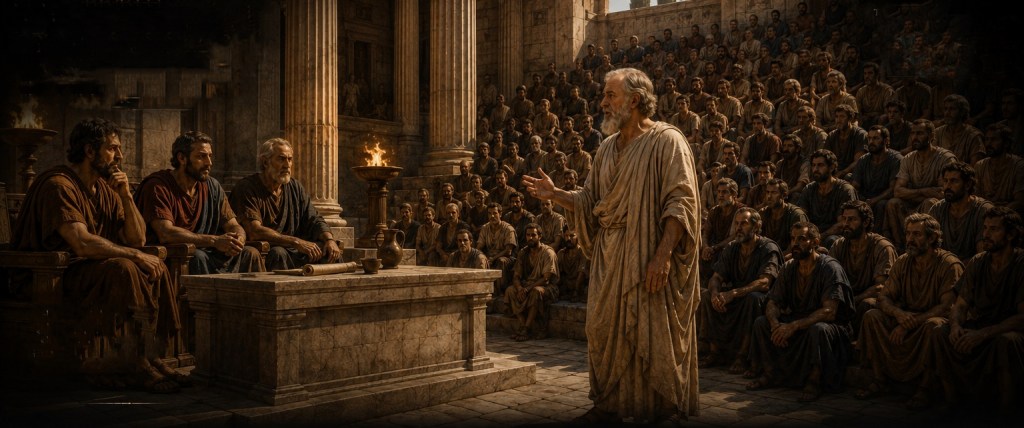
399 BC in Athens. The city is still recovering from the war, plague, and the recent overthrow of a tyrannical oligarchy. Amidst the prevailing fear and suspicion, the elderly philosopher Socrates, known for his barefoot, eccentric, and incessant questioning, has become a target. The establishment views him as dangerous because he exposes the ignorance of the powerful, associates with controversial figures such as the traitor Alcibiades, and questions the city’s gods. Three men, the powerful politician Anytos, the orator Lycon, and the young poet Meliitos, bring formal charges against Socrates: impiety (denying the state’s gods and introducing new ones) and corrupting the youth of Athens. They are seeking the death penalty. Plato, Socrates’ renowned pupil, invokes Goddess Athena for divine aid as the trial approaches, while Socrates’ devoted companions convene at Plato’s residence to provide encouragement and plan. During Socrates’ last address in the agora, he engages in a heated discussion with Aristophanes, the playwright. Socrates rejects the offer from the famous speaker Lysias to compose a defense for him in court. He is unwilling to beg, put on mourning clothes, or use emotional appeals to sway the jury. His life, he asserts, has been his defense. The Heliaia court, an open-air venue, hosts the trial with 501 randomly chosen jurors. The prosecutors systematically built their case, portraying Socrates as an atheist, a sophist skilled in distorting arguments, and a negative influence on the youth. His defense takes the form of the now-legendary “Apology” by Socrates. The jury’s vote resulted in Socrates’s conviction. They asked him to suggest a different punishment during the sentencing. Instead of suggesting exile or a substantial fine, which the jury would likely have agreed to, Socrates mockingly proposes a minor penalty and asserts he merits complimentary meals forever for his service to the public. His arguments deeply offended the jury, leading them to cast a decisive vote for the death penalty, involving the drinking of hemlock.
STORY STRUCTURE
ACT I – DAY ONE
Temple of Parthenon, Ancient theater, the Agora, the court, Plato’s house.
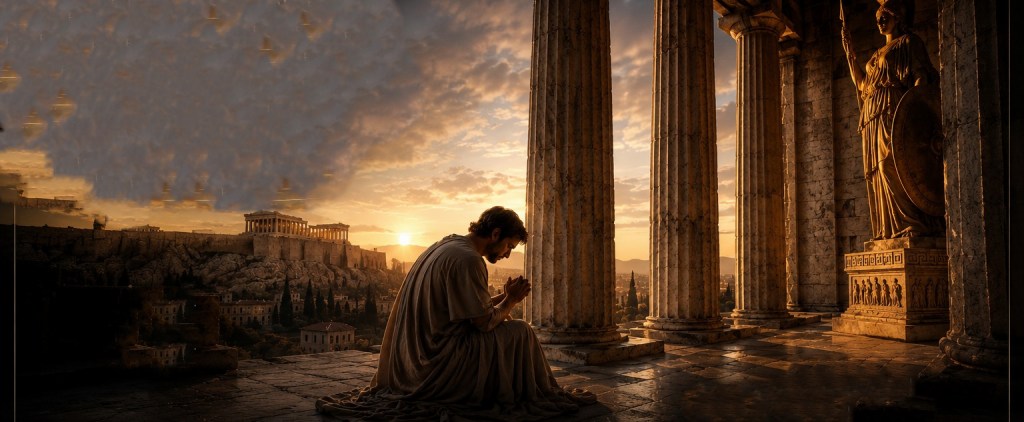
Plato prays at the Temple of Parthenon for his teacher’s safety. Plato prays for Socrates’ safety, revealing the emotional and spiritual stakes behind the intellectual legend.
Aristophanes meets friends in a theater, and gossip.
In the agora, a heated public discussion breaks out about Socrates: some see him as a corruptor of youth and enemy of the gods, while others defend him as Athens’ conscience.
Socrates confronts public opinion. Socrates himself addresses the citizens, calmly dissecting their fears and beliefs in confrontational yet disarming dialogue.
Aristophanes and Socrates in a long intellectual duel. A key set piece is a sharp, ironic encounter between Socrates and Aristophanes, the comic playwright who once mocked him, now forced to confront the man behind the caricature.
Final preparations for the open-air court area continue.
The day concludes at Plato’s house, where Socrates gathers with his followers, debating virtue, justice, and the meaning of courage on the eve of the trial.

SYNOPSIS
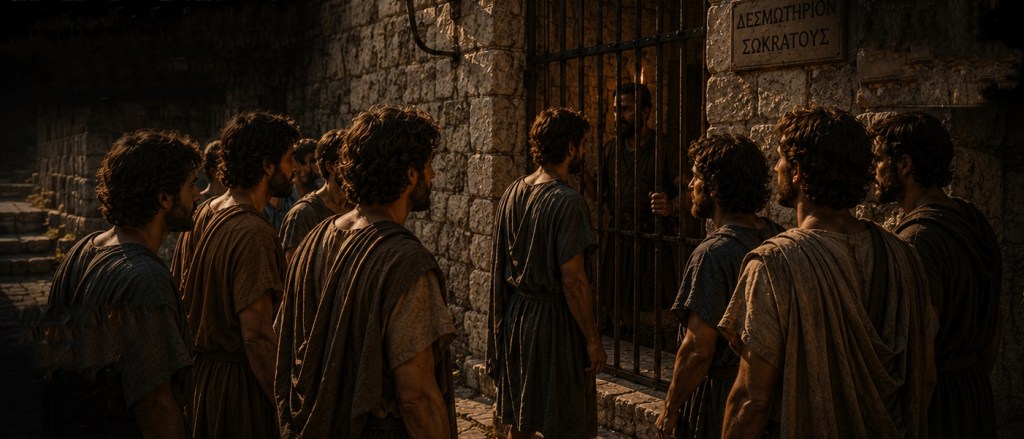
On the last day, Socrates’ followers visited him for the last time, as his friends organized an escape. He offers them only wisdom, no escape or tears. He discusses the soul’s eternal nature, the value of virtuous living, and his aspirations for a superior afterlife. He reassures his students who are mourning, asking them to honor him by pursuing truth instead of grieving. Socrates calmly assures them that his execution is a necessary choice for the city’s well-being.
PITCH DECK
IMMORTAL APOLOGY
Three days before his execution, Socrates confronts politicians, poets, priests, and finally death itself, transforming a trial into one of history’s greatest battles between truth and power.